


Leather Ottoman Buying Guide: Size, Shape and Leather Types
How to choose a leather ottoman: the right height and size for your sofa, square vs. round shapes, leather types, firmness and color.
A leather ottoman looks simple, but the right one depends on three choices: size, shape and the leather itself. Get those right and it becomes the hardest-working piece in the room.
This guide walks you through each decision, with the measurements and details that matter before you buy.
1. Start With Size
Height
A common rule of thumb is to match the ottoman to the seat height of your sofa or chair, or go an inch or two lower. Most sofa seats sit around 17 to 19 inches from the floor, so an ottoman between 13 and 18 inches covers almost every use:
- 13 to 15 inches works best as a footrest or a low table with a tray.
- 16 to 18 inches doubles comfortably as an extra seat for guests.
Width and footprint
In front of a sofa, leave about 14 to 18 inches between the sofa and the ottoman so people can stretch their legs and still walk past. Next to an armchair, choose a piece narrower than the chair itself, so it reads as a companion rather than a second seat.
For reference, our square leather ottomans measure 18" W x 18" D x 16" H, and our round leather poufs measure 20" across and 13" high. Need something different? Our artisans can craft a square ottoman to custom dimensions on request.

2. Choose the Shape: Square or Round
Shape changes how the ottoman behaves in the room.
- Square ottomans have a flat top and clean edges. They hold a tray steadily, line up with modern sofas and coffee tables, and look tailored in pairs or groups of three or four.
- Round poufs are softer in outline and easy to move around. They slip into corners, soften a room full of straight lines, and are the classic Moroccan shape, often with an embroidered top.

Square: flat top, clean edges

Round: soft outline, embroidered top
If you plan to set drinks or books on it, choose square. If you mainly want a footrest you can move from room to room, round is hard to beat. Our side-by-side guide to round vs. square Moroccan poufs goes deeper, and ottoman vs. pouf vs. hassock explains the difference between the names.
3. Understand the Leather
Two leather ottomans can look alike in a photo and age very differently. Here is what to check.
Real leather vs. bonded or faux leather
Real leather is cut from a hide, so it keeps its natural grain and fibrous structure. Bonded leather is made from leather scraps mixed with binders and coated, and faux leather is a plastic surface such as PU or PVC on a fabric backing. Bonded and faux finishes can look smooth at first, but they tend to peel or crack with daily use, while real leather softens and develops a patina. Still deciding between leather and fabric? See our leather vs. fabric ottoman comparison.
Full-grain, top-grain and split leather
These terms describe which layer of the hide is used. Full-grain keeps the complete outer surface with all its natural markings. Top-grain is lightly sanded for a more uniform look. Split leather comes from the lower layers and is usually finished with a coating. The more natural surface a leather keeps, the more character it shows over time.
How the leather is tanned
Vegetable-tanned leather is treated with plant-based tannins. It feels natural, keeps a slightly firm hand and deepens in color as it ages. Our square leather ottomans are made from genuine vegetable-tanned leather, cut and hand-stitched in Morocco.

Goat leather
Goat leather is thin, supple and strong for its weight, which makes it ideal for embroidered poufs. Our round poufs are made from 100% genuine goat leather, naturally dyed and sun-dried, with the embroidery stitched by hand. To learn how to recognize real handwork, see 5 ways to spot a genuine Moroccan pouf.
4. Decide How It Should Feel
Comfort depends on the filling as much as the leather.
- Firm seating keeps a crisp shape and stays steady as a seat, a footrest or a surface for a tray.
- Soft seating gives gently under pressure, which feels relaxed under your feet and looks more casual.
You can also choose between a pouf that arrives stuffed and ready to use, or unstuffed, so you fill it yourself with spare blankets, towels or an insert. Our guide to stuffing a leather pouf shows how to get a firm, even shape.

5. Pick a Color That Fits the Room
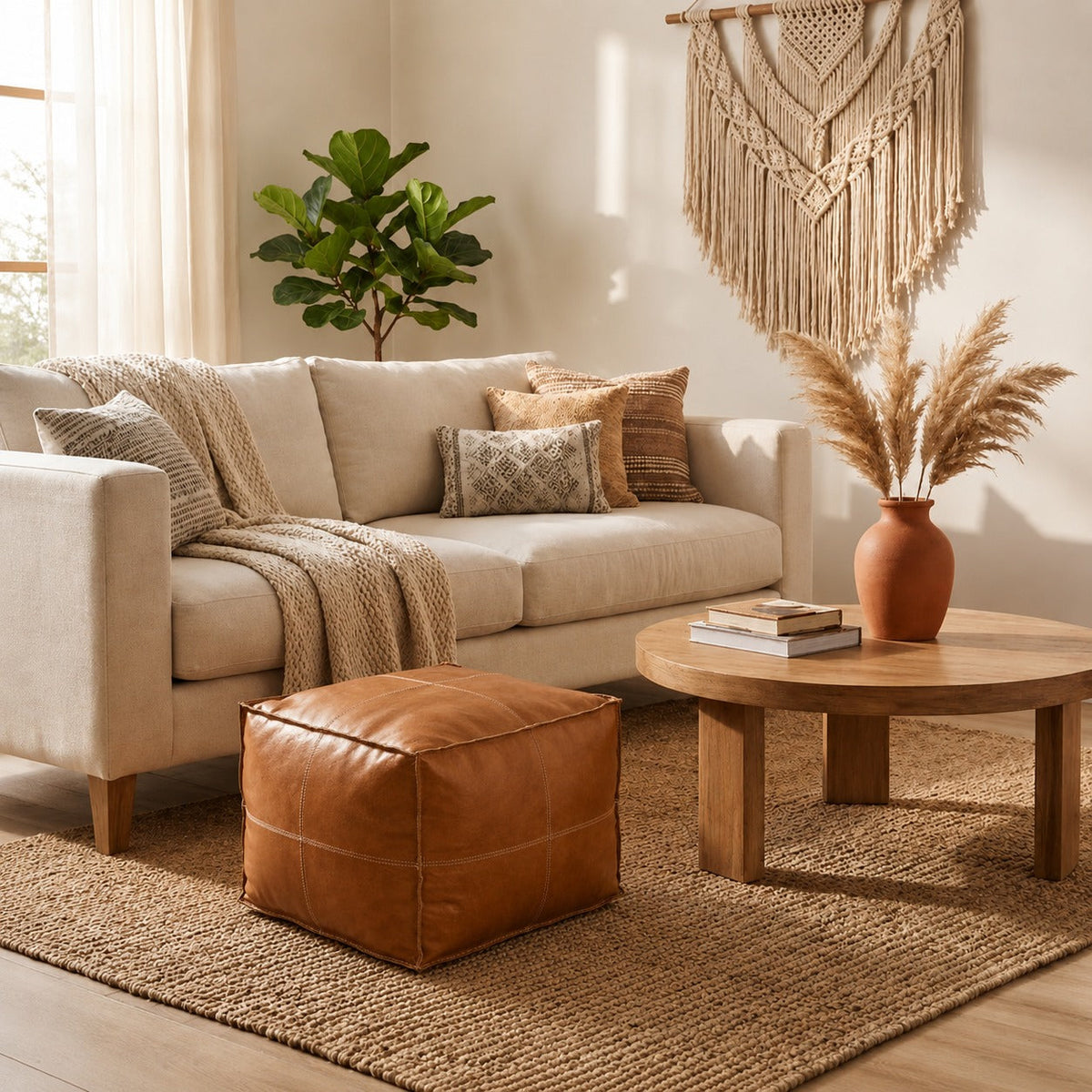
- Cognac and brown warm up wood floors, linen sofas and mid-century rooms.
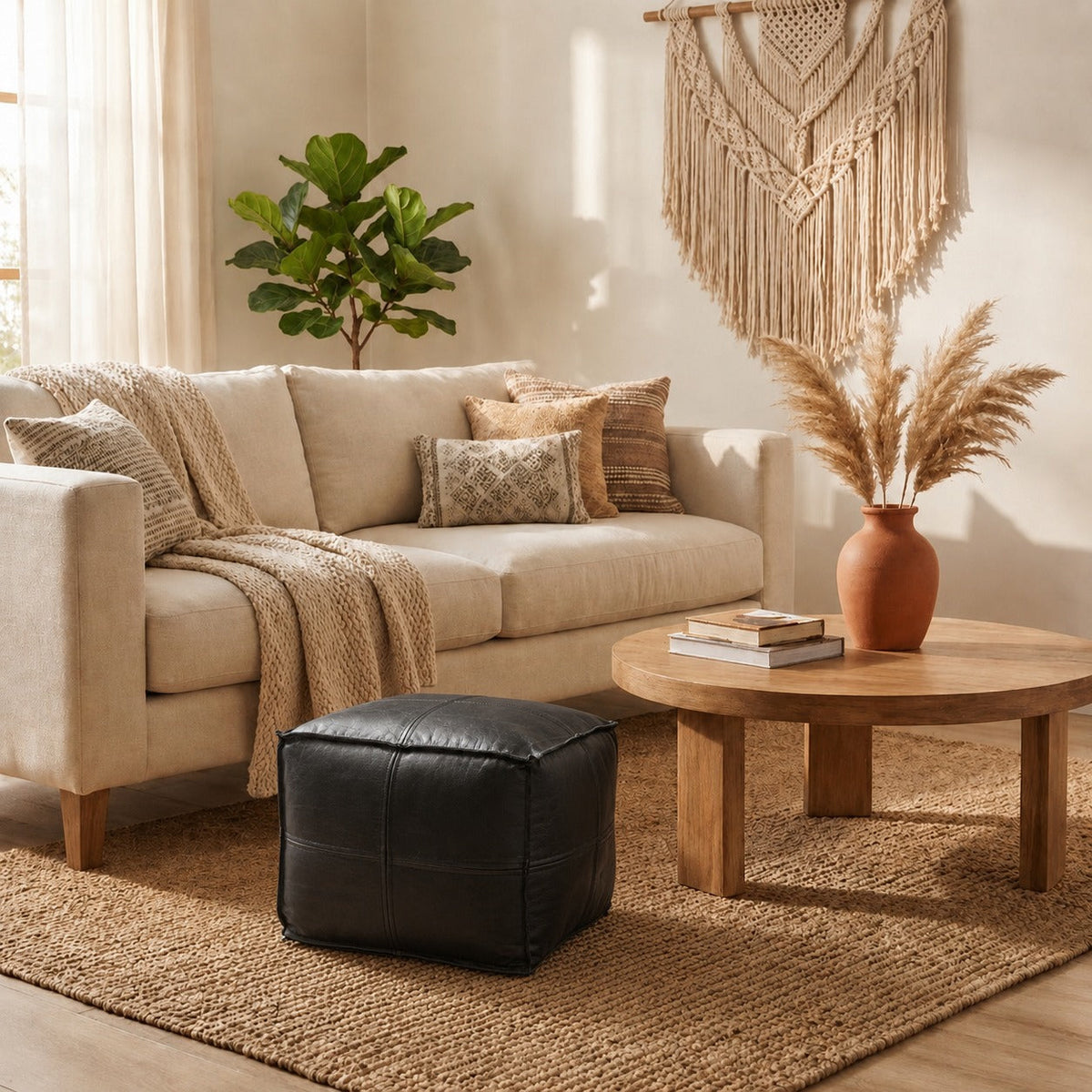
- Dark brown and black add depth to modern, industrial and minimalist spaces.
- White and silver pearl brighten Scandinavian, coastal and contemporary interiors.

White

Silver pearl

Black
Our square ottomans come in all six of these colors, and our round poufs in more than 25, from classic tan to navy, forest green and burgundy.
6. One Ottoman or a Set?
One ottoman reads as an accent. Two placed side by side in front of a sofa work as a soft coffee table, and three or four grouped together create flexible seating for guests. Square ottomans are available as a single piece or as a set of 2, 3 or 4, which makes it easy to keep every piece matching.

Shown with our tan woven leather headboard.
A pair also works beautifully at the foot of the bed. Our guide to matching a headboard, bench and pouf shows how to tie the bedroom together, and 8 ways to style a leather pouf has more ideas.
7. Care for It So It Lasts
- Dust with a dry, soft cloth and wipe spills right away.
- Apply a leather conditioner once or twice a year.
- Keep it out of strong direct sunlight to slow fading.
- Expect small variations in tone and stitching. On a handmade piece, they are part of its character.
For a full week-by-week care routine, plus the honest pros and cons, read is a leather ottoman worth it?
Quick Checklist Before You Buy
- Height: within an inch or two of your sofa seat.
- Clearance: about 14 to 18 inches from the sofa.
- Shape: square for a tray and a tailored look, round for flexibility.
- Leather: real hide, ideally vegetable-tanned or full-grain, never bonded.
- Comfort: firm for seating, soft for a footrest.
Ready to choose? Browse our square leather ottomans, or explore every shape and color in our leather ottomans and poufs collection. Shipping is always free.
Frequently Asked Questions
What size leather ottoman should I get?
Match the height to your sofa seat, or go an inch or two lower, and leave about 14 to 18 inches between the sofa and the ottoman. An 18-inch square ottoman that stands 16 inches high suits most standard sofas and armchairs.
Is a square or round leather ottoman better?
Square is better if you want a stable surface for a tray or a tailored look. Round is better for small spaces and for a pouf you can move easily.
What is the best leather for an ottoman?
Choose real leather over bonded or faux leather. Vegetable-tanned and full-grain leathers keep the most natural surface and develop a rich patina over time.
Can a leather ottoman be used as a seat?
Yes. A firmly filled ottoman around 16 inches high makes a comfortable extra seat. For a footrest, a softer fill feels more relaxed.